|
Organic
Gardening Tips
provided by Terra
Viva Organics
New Products
Attract Beneficial Insects
to Your Garden
Time to Start Your Tomatoes
Make Your Own Bee Condo
Sugared Asparagus
We have a number of exciting products that we can't wait
to show you:
- 1. My
First Garden - A child's garden kit complete with
small gloves, a soil scoop, mini watering can, fertilizer
(Flower Power), and 15 seeds each of Scarlet Runner
Beans and Giant Sunflowers (yes, the grow over 15
ft tall!)
- 2. Bee
Straws - Use these straws to make your own Orchard
Mason Bee House. The straws can be used on their own
with some insulation (see story below) or to line
holes drilled in wood, allowing you to re-use the
holes again.
- Circle
Hoe - a unique hand tool especially made for tight
spaces around seedlings and container plants.
- Orchid
Twists - You just have to see how beautiful these
orchid supports are. Made of stainless steel.
by Sharon
Hanna
For years, well-meaning gardeners routinely maimed, swatted,
sprayed and squished every bug they could get their hands
on. However careful observation of nature and the move
to organic practices have shown that encouraging beneficial
insects is one way to give Mother Nature a hand.
Lets look at three common
beneficials, and how to attract them to your garden:
Beetles. You undoubtedly
know these large, fast moving, shiny metallic-blue-black
beetles! They snooze underneath pieces of rotten logs
and stones and are nocturnal, dining ravenously after
dark upon cutworms, root maggots, and slug eggs, miscellaneous
larvae and pupae of undesirables, flea beetles, and
leaf hoppers.
To attract more beetles,
imitate nature. Along a shady edge, away from foot traffic,
dig a trench three to six inches deep, and a foot wide.
Plant mint, or lemon balm, or even red or white clover,
along the inside edges. Drop shovels of peat moss, leaf
mulch, coniferous needles, whatever organic material
you have, along the slopes and then place a couple of
big, flat rocks in the ditch. The beetles will hide
under the rocks in the daytime.
Syrphid Flies aka
"hover flies" are important pollinators, and their larvae
prey on many 'bad' bugs, but aphids are their favourite.
Once hatched, the larvae decimate aphid families in
a hurry. The 1/2 inch creature is often mistaken for
a "bad" worm or slug, so if you come across a legless,
see-through greenish-beige creature, slightly pointy
at one end, do not kill him, but wish him 'bon appetit'!
To attract syrphids,
choose plants of the umbelliferae family: fennel, dill,
caraway,
parsley,
coriander,
yarrow, or allow carrots to winter over. All produce
beautifully symmetrical seed-heads called umbels, attracting
a host of beneficials. According to a recent Oregon
State University study, buckwheat is also extremely
attractive to syrphids. They also like cornflowers (bachelor
buttons), marigolds, chamomile, coreopsis, and feverfew.
Lady Beetles, also
known as "ladybugs", feed heavily on aphids. Become
familiar with the ladybug in the larval stage. It looks
a bit like an elongated grey-black dragon with many
little legs, and orange to red markings.
All stages of ladybugs
from larvae to adult feed on aphids. Ladybugs are attracted
to cosmos, especially white, and to goldenrod, caraway,
fennel, yarrow and other umbelliferae. All are easily
grown from seed. Lady beetles also like to lay their
eggs amongst the long grass, so try to leave a strip
un-mowed if you can.
In general, beneficial
insects are attracted to plants from families including
compositae (daisy family); the mint family (all kinds
of mints, lemon
balm, and more); umbelliferae (carrot family, parsley,
fennel); and the brassica family, a huge family which
includes cabbages, cauliflower, oriental
greens, arugula, radish
and more. These produce flowers containing the type
of nectar which beneficial insects use as fuel for flight
and movement.
Also it is good manners
to provide your insect guests with a drink, in this
case water, to wash down the aphids. This can be achieved
simply: placing a plastic tray or any kind of pan in
your garden and fill it with water. Put rocks in the
water for them to stand on.
© Sharon Hanna is a Horticultural
Writer for Terra Viva Organics
by Arzeena
Hamir
Tomatoes are one of the easiest vegetables to grow from
seed
and now is
the time to start tomato seeds indoors. The seeds themselves
are easy to handle and can be planted in any type of container
you have around the house. I prefer to start 3 seeds in
2" pots; however, yogurt containers, milk cartons, &
even egg cartons can all be used.
The key to starting tomato
seed is:
- Pre-moisten your potting
soil before planting
- Don't plant the seed
too deep - ½" is usually enough
- Keep the container
warm - I like to keep my containers at about 75 F
(25 C)
- Keep the container
moist but not soggy - try not to overwater
- Once the seedlings
are up, move them to a cool but bright location.
A week after the seedlings
are up, transplant them into individual pots along
with some compost or worm casts for food. Within
another 3 weeks, the seedlings will outgrow their
containers & will be potted up again. This time,
they're potted into 6" containers where they will
stay until they go into the garden.
Arzeena Hamir is
an Agronomist & President of Terra Viva Organics.
She specializes in educating home gardeners about
organic vegetable production. You can see more of
her work at The Vegetable Garden - Suite101.com.For more
gardening information, you can also e-mail her at
arzeena@tvorganics.com
by Derry
Walsh
Many native solitary
bees are found throughout North America and together
with other bee species such as honeybees and bumblebees,
are important pollinators of fruit and vegetables.
When the daytime high
temperature reaches 14 C (57°F), the Blue Orchard
bee starts to emerge. The males emerge a few days
before the females. They mate and then the female
looks for places to lay her eggs. She prefers to
lay her eggs in small holes, often in tree trunks
or fences. When she has found a suitable nest, she
collects many grains of pollen, mixes it with nectar,
and lays an egg on the lump of pollen. Then she
collects wet mud or other materials and makes a
wall as protection from parasites and predators.
After one cell is closed with mud, she sets out
to collect pollen and nectar for another cell, and
she continues until she runs out of eggs.
You can attract Blue
Orchard Mason Bees into your garden by building
your own "Condo" for them. It's easy and can be
made with recycled materials to boot.
Materials needed:
- 1 waxed milk carton
or juice container, non-transparent
- Screws
- 15 Paper
Straws
- 2 rubber bands
- Wood Glue
- Newspaper
- Foam (or any soft
stuffing for insulation)
Prepare the Condo
as follows:
Screw a one liter
waxed milk or juice container to the outside of
your garage, shed, or house wall, in a sheltered
spot out of the wind. These nests are best attached
to a sunny, southern or eastern location, close
to your garden so these bees can pollinate your
fruit trees. The height is not that important, the
bees seem to nest in straws anywhere from three
to 20' above ground, but put it at eye level so
you can watch the bees in action
Cut the straws approximately
in half (some slightly less than 6" and some slightly
more than 6") and bundle the straws together with
an elastic band. Note that the uneven length of
nesting straws is a cue for bees to orient to their
nest.
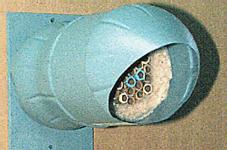
Cut five x 6" squares
of newspaper and glue them around the bundle for
the first layer of insulation. Place another rubber
band over the newspaper to keep it snug. Wrap the
bundle with foam to insulate the bees from extreme
cold and heat. Insert the bundle of straws and insulation,
as one unit, into the waterproof container. If there
is extra room around the straws, fill it with more
foam.
Each female solitary
bee will use about two and a half of the six inch
straws per season. To increase the chance of bees
finding your homemade condo, you can decorate your
nest with pale colored paint. In addition you could
colour the end of a few of the nesting straws to
make active nesting straws easier to locate for
returning bees.
In mild winter areas
(Zone 7+) leave the nests out-of-doors all year.
You could move them to a more sheltered spot out
of the worst of the rain and snow and move them
back to your ideal spot in mid February. Each year,
provide more empty straws for new nests.
Questions about Orchard
Mason Bees and making condos can be sent to Derry
at wchase@interchange.ubc.ca
|