
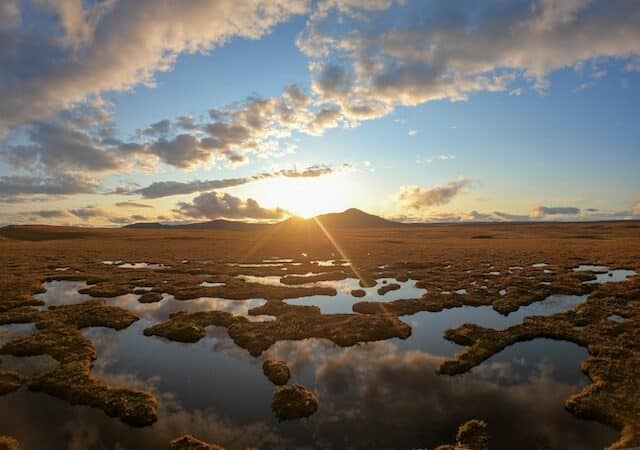
Peat bogs are areas of great natural beauty, as well as being rich in wild plants, insects and animals. Yet we are still using peat in our gardens and putting these irreplaceable habitats under threat. Michaela Strachan wants to know why.
Did you know that 30th July is International Bog Day? Well, you’d be forgiven if you didn’t, but it is. It’s a day to celebrate these rare and unique habitats and to make people aware that they are sadly fast disappearing. There are a few reasons why this happening, namely drainage for agriculture, forestry and the commercial extraction of peat for the horticultural industry. And that brings me to the subject of this month’s article: PEAT, PEAT, GLORIOUS PEAT!

Now I don’t want to go off on one, but why oh why are people still using peat? I recently did an item on Countryfile about bogs and peat and was astonished to learn that despite the fact that environmentalists have been banging on for years about why gardeners shouldn’t use peat, sales have risen dramatically. Has everyone just put their heads in their peat-filled sand pits or does no one care? Maybe everyone’s just forgotten what the whole issue is about or simply got too bogged down in trying to make their gardens grow! For those caring wildlife gardeners amongst us, I thought I’d do a little refresher course.
First of all, what is a peat bog?
Well, it’s a wetland site with poor drainage. Peat bogs are fed by rainwater and the soil builds up its own water table and acidity. Sphagnum mosses grow and decay eventually forming layers of peat, then peat mounds many metres deep. This process takes thousands of years, which is why sustainable large-scale peat extraction is impossible; the extraction is always faster than the growth. Habitats like these simply take too long to grow back.
Why are they so important?
Because so many peat bogs have been damaged, they are now very rare. Around 94% of Britain’s peatlands have been destroyed or damaged, and peat mining still goes on, and will continue to go on while demand is high.

If you’ve ever been to a peat bog you’ll know what amazing places they are. If not, I recommend a visit. Peat bogs are rich in diversity of plants and wildlife, some of which are unique to these environments. They are home to thousands of insects including butterflies, dragonflies and the rare raft spider. Nearly a thousand different flowering plants grow there, including carnivorous plants such as the great sundew as well as mosses, fungi and lichens. Birdlife is abundant: waders, wildfowl, nightjar, winchat, merlin, short-eared owl, golden plover, snipe, sparrowhawks and – as I witnessed myself when I recently went to the restored Fenn’s Whixall and Bettisfield Mosses site in Wales – hobbies, which were feasting on the numerous dragonflies.
Peat bogs are also rich in social and biological history. They contain irreplaceable materials dating back to the ice age. Many objects are preserved in peat bogs, things like ancient boats, trees and even bodies.
What is peat used for?
Peat was used for centuries as fuel, but these days gardeners get through huge amounts in the form of compost, grow bags and peat pots; the solid bales are even used for garden walls.
So now you’ve all been reminded about the huge environmental impact that using peat has, I’m sure you’re very keen to know what you can do about it. It’s very simple, DON’T BUY PEAT. You’ll be doing the environment a huge favour. There are many alternatives that gardening outlets can recommend; here are a few.
1. Home-made compost – this is an obvious soil improver and one that I hope you have all started to make by now. Not only does this reduce your garden and household waste, it is also extremely environmentally friendly.
2. Coir – this is the most popular alternative to peat when used as a growing media. It’s a by-product of the coconut industry and is imported from Sri Lanka, India and the Philippines. It comes as a tough, fibrous, pithy material or as dust and has proved to be very successful for bedding plants, germinating seeds and propagating cuttings.
3. Leaf mould – again this is very environmentally friendly. After two years, leaf mould can be sieved and used as a great peat substitute for improving the soil.
4. Manure – if you live on or near a farm this is ideal! Well-rotted cow, chicken and horse manure are particularly good.
5. Bark chipping and even sheep’s fleece can be used as effective mulch.
6. Pine needles and composted bracken are excellent if you need to increase the acidity of your soil.
At present, alternatives to peat account for less than 30% of the market, which if you ask me is pretty unimpressive! A staggering 2.55 million cubic metres of peat are used every year in the UK for horticultural uses.
So next time you have a little peat memory lapse remember this: you can have peat in a bag or you can have peat in a bog but you can’t have both. We can’t rely on the government to make the decision, so once again it’s up to the consumer to make the choice. I hope you’ll all make the right one!
Stay gardening wild, and be a proud and peat-free gardener.
Location photographs courtesy of A-Z Botanical Collection Ltd, London
Articles reprinted with permission from Greenfingers.com
