
My sister got married two summers ago and honestly, I remember the smell of her bouquet better than I remember most of the ceremony itself. Peonies, mostly, with a bit of eucalyptus tucked near the stems. Three days later half the petals were already on her hallway floor and nobody had the heart to sweep them up straight away. That’s flowers for you really, they give you everything at once and then they’re gone before you’ve had a proper look at them.
That’s basically why flower preservation is a thing people search for. Weddings, funerals, anniversaries, or sometimes just a really nice bunch from the local florist that someone doesn’t want to watch die on the kitchen table. I’ve written about weddings and home stuff for years now and this topic comes up a lot more than people expect, so here’s what I actually know about it, no padding.
Why People Even Bother
Not every bouquet is worth preserving, and that’s fine to say out loud. A supermarket bunch grabbed on a Tuesday probably isn’t going in a shadow box. But a bridal bouquet? A corsage from a first dance? Flowers someone handed you on a genuinely hard day? Those hold something a normal bunch doesn’t, and it’s hard to explain that to someone who wasn’t there when it happened.
Wedding flower preservation specifically has turned into its own little corner of the wedding industry. Couples drop real money on florals for one single day, and photos, as nice as they are, only get you so far. There’s something a preserved wedding bouquet does sitting on a shelf five years on that a photo simply can’t. It’s the actual thing. Not a picture of the thing.
So What Are the Actual Options
There isn’t one right method here, I wish there was. It depends on the flower you’re dealing with, how much patience you’ve got, and honestly what you’re prepared to spend.
Air drying is where most people start because it costs basically nothing. You hang the flowers upside down somewhere dark and dry with a bit of airflow and you wait it out. Cheap, simple, though results can be a little hit or miss depending on what you’re drying.
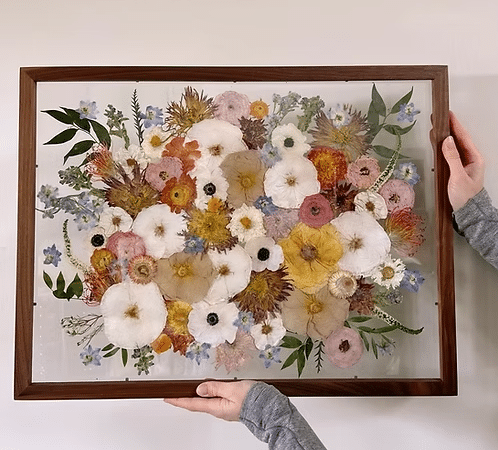
Pressed flower preservation goes the other way entirely, flattening the blooms under a heavy book or in an actual flower press until they’re paper thin. Good for framing, or slipping into a card that someone’s actually going to keep.
Silica gel drying sits in between the two. Faster than plain air drying, and it holds colour a lot better, which is why professionals reach for it with anything delicate, roses especially.
Freeze-drying is the one people bring up when budget isn’t really the concern. Moisture gets removed at very low temperatures and the flower barely changes shape at all. Not cheap. But when it’s done right it’s honestly a little unbelievable how close it looks to the real thing.
Resin preservation sets flowers into clear resin, so you end up with things like paperweights or jewellery. Feels more like a craft hobby than a preservation method if I’m being honest.
Glycerin preservation is different again, the stems soak up a glycerin and water mix so the petals stay soft rather than going brittle. Works well on foliage in particular.
None of these is “the best” one across the board. It really comes down to what you want it to look like once it’s finished, and where it’s going to end up.
Dried Flower Preservation Is Still What Most People Go For
Of everything above, this is the one most people actually try, and it’s not hard to see why. Dried blooms look good almost anywhere in a home, they don’t ask for any upkeep once they’re done, and things like roses, lavender, baby’s breath and eucalyptus dry surprisingly well without losing much colour at all.
Doing it yourself is genuinely simple. Strip the extra leaves off the stems, tie a small bunch together with string or a rubber band, hang it upside down somewhere dark and dry, then leave it alone for two to three weeks. That’s most of it. No equipment needed, which makes it a decent place to start if this is your first time trying any of this.
Pressed Flowers, for Anyone With a Bit More Patience
If crafting is more your thing than décor, pressed flower preservation opens up a fair bit, cards, bookmarks, framed pieces, resin jewellery further down the line. It asks for patience more than skill, which is a relief honestly.
Thin-petalled flowers work best, pansies and violets and daisies are usually a safe bet. Sandwich them between sheets of absorbent paper, weigh them down under something heavy, or use a proper press, and leave them for a week or two. Once they’re completely flat and dry, seal them under glass or laminate so moisture can’t creep back in.
The end result feels quieter than dried arrangements. Suits a scrapbook, or a gift that’s a bit more thought through than something bought last minute.
When Paying Someone Is Actually Worth It
A lot of this you can do at your own kitchen table with almost nothing, but wedding bouquets are usually the one exception worth making. Professional flower preservation services have freeze-drying setups and resin techniques that are genuinely hard to pull off at home no matter how many tutorials you sit through beforehand.
A decent preservationist can also rebuild a bouquet’s shape after it’s already wilted a bit, slow down further colour loss, build a proper display, shadow box or glass dome or resin piece, whatever suits, and handle bigger or more delicate arrangements without them falling apart mid process. For something with the weight of a wedding bouquet, spending on real flower preservation techniques usually turns out to be money well spent.
A Few Things That Genuinely Matter
Don’t wait around too long before starting. Flowers lose moisture from the moment they’re cut, so a day or two makes a real difference either way.
Pick blooms that are just opening rather than ones already fading. They tend to hold up better no matter which method you go with.
Keep the whole process dry. Moisture is really the main thing working against you here, more than anything else on this list.
Keep it out of direct sun too, during and after, since that’s usually what fades colour the fastest.
And once it’s finished, handle it gently. Dried and pressed flowers stay more fragile than people expect, even well after they look fully set.
Last Thing
Preserving flowers was never really about the flowers themselves. It’s about not being quite ready to let go of whatever they meant to you at the time. Whether that’s garden roses hanging in a kitchen, pressed petals inside a handmade card, or a wedding bouquet handed off to someone who knows what they’re doing, there’s usually a way to hold onto it a little longer than nature had in mind.
Author: Stag Ridge Mercantile
