AMARANTHUS – Amaranth
(Name derived from a-not, mairaino-to whither, refers to the everlasting character of the flowers)
Coarse plants, but very showy, the various sorts of Am...

Professional Gardening Tips

AMARANTHUS – Amaranth
(Name derived from a-not, mairaino-to whither, refers to the everlasting character of the flowers)
Coarse plants, but very showy, the various sorts of Am...

BARTONIA (Mentzelia) (Blazing-star)
(Named for Dr. Barton, American botanist)
Were it not for the straggling growth, Barlonia aurea (Menlzelia lindleyi) would be a much more popular...

CLARKIA
(This is a native of our Western States and was first found by members of the Lewis-Clark Expedition. It was consequently named for Captain Wm. Clark)
These lovely annuals a...

COSMOS (Cosmea) (Mexican-aster)
(The name comes from the Greek for orderliness, hence an ornament or a beautiful plant)
The Cosmos is not as impatient about coming into bloom...

DATURA Floripondio (Trumpet flower)
These large-flowered annuals are related to the common Jimson weed. Their flowers are trumpet-shaped, white, purple, or yellow in color, and sometimes 6...

The blossoms are, as indicated by one of its common names, orange Daisies but in some forms the colors are very light, grading through salmon to white. The flowers are about 2 1/2 inches in diame...
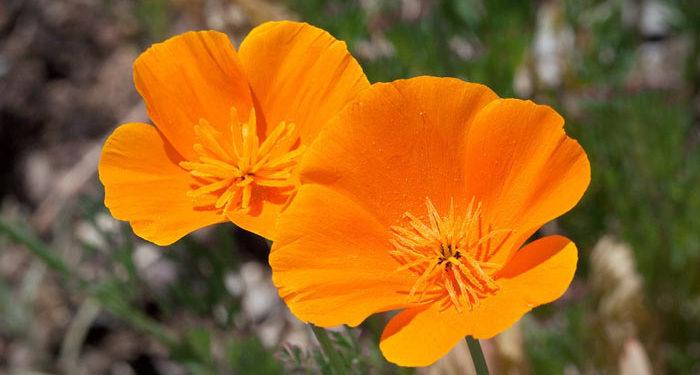
California-poppy
(Named for Dr. Eschscholtz as the result of an expedition to explore the botany of what is now California in 1815. Named by Chamisso, a companion naturalist)
The si...

EUPHORBIA Spurge
(Named for Euphorbus, physician to the King of Mauritania)
This is an interesting genus of plants, which give off a milky juice when any part is bruised or ...

GILIA
(Named for Philipp Salvador Gil, Spanish botanist)
The Gilias are related to Phlox and, like them, have funnel or salver form flowers.
Gilia capitata, Globe Gilia, is a...

IBERIS – Candytuft
(Name from Iberia, the ancient name of Spain. The word Candytuft was originally Candia tuft, signifying the tufted plant from Candia)
The neat heads of Cand...